
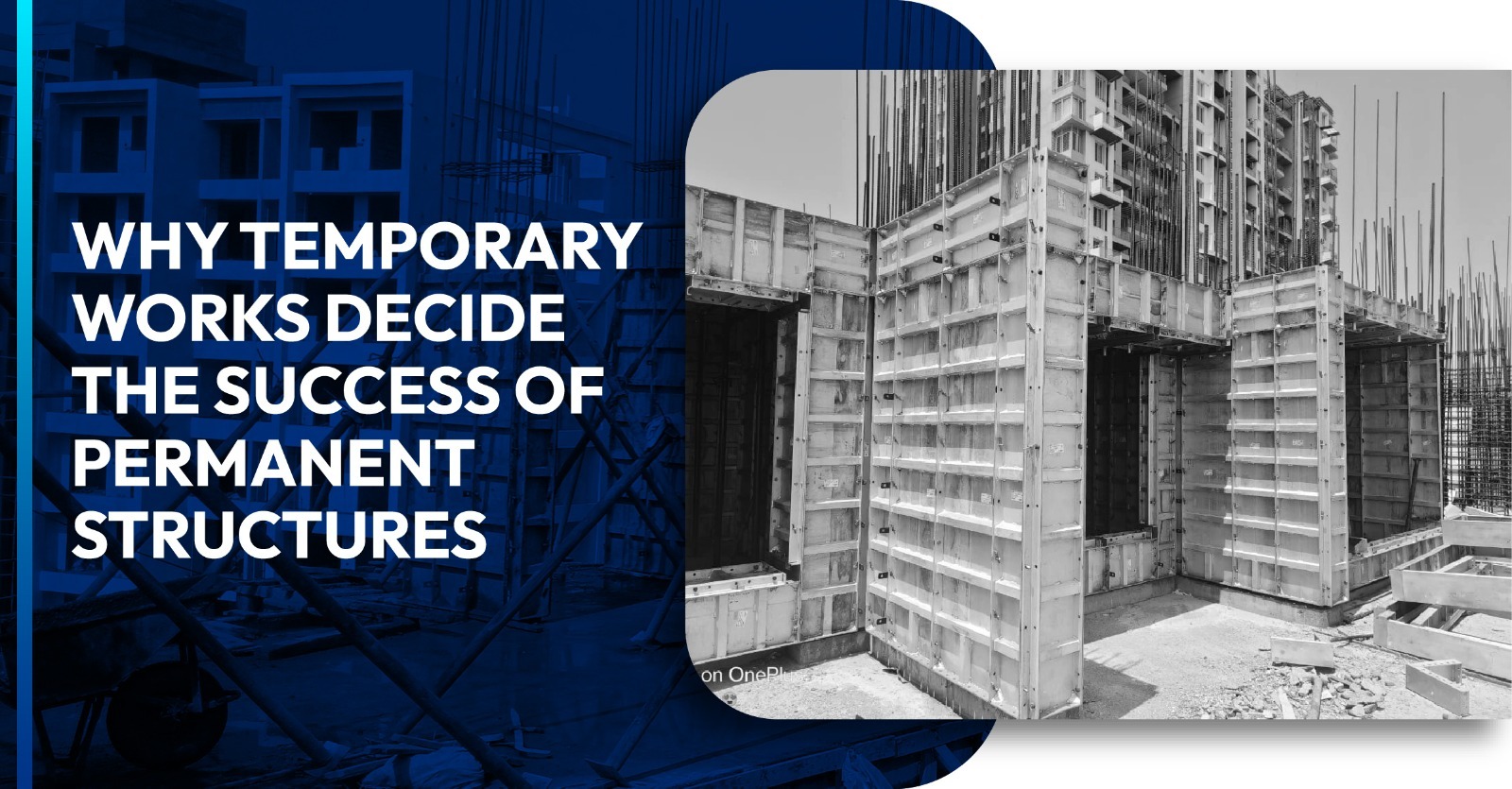
In construction, permanent structures get all the attention, design intent, structural strength, finishes, and aesthetics. But what often determines whether a project succeeds or struggles is something far less visible: temporary works.
Temporary systems are not construction accessories. They are the framework within which construction actually happens. From aluminium formwork that ensures the accuracy of slabs and walls to scaffolding systems that control movement and access to protection screens and wingspan platforms that manage risk at height, every permanent element relies on temporary systems to exist in the first place.
The Cost of an Afterthought
When temporary works are treated as an afterthought, projects pay the price:
- Misaligned formwork leads to rework.
- Improvised access creates safety hazards.
- Unprotected edges slow down work and increase risk exposure.
The Engineered Advantage
On the other hand, when temporary works are planned as engineered systems, outcomes change dramatically:
- Aluminium formwork ensures repeatability and dimensional consistency across floors.
- Scaffolding systems create predictable access routes that keep labour productive.
- Protection screens mitigate falling-object risks and wind exposure in high-rise environments.
- Wingspan platforms extend working areas safely beyond slab edges, allowing uninterrupted progress.
Globally, advanced construction markets treat temporary works as part of the core build strategy, not a site-level adjustment. The focus is on integration, not isolation. Each system supports the other, creating stability, safety, and speed.
Permanent structures may define skylines, but it is temporary works that decide how smoothly, safely, and efficiently those structures rise. Ignoring them is not just a technical oversight; it’s a strategic one.